The 10th edition of the Commercial Vehicle Forum (CVF presented by JK Tyre), at Conrad Pune, was a landmark moment for India’s commercial vehicle industry, and by every measure, a resounding success. With over 500 delegates and 60 speakers converging under one roof, the energy was electric, the conversations were bold, and the vision was unmistakably forward-looking. CVF 2026 wasn’t just an event; it was a statement about where India’s Road Transport and CV ecosystem is headed.
Setting the tone for the day, the forum opened with a powerful research presentation by Jinal Shah, Founder & CEO of Expandus Consulting, on India’s Freight Transformation Decade (Reimagining Commercial Mobility for Viksit Bharat). Shah painted an ambitious picture of India’s economic trajectory, projecting GDP growth from $4 trillion to nearly $30 trillion, urbanisation rising from 37% to 65%, and citing NITI Aayog estimates that 70% of the country’s infrastructure is yet to be built. He highlighted that heavy commercial vehicles, while making up only a quarter of industry volumes, carry 83% of India’s freight, with replacement cycles now driving demand more than fresh expansion, and alternate fuels poised to climb from roughly 15% of the mix today to 42% within the next decade.
Delivering the Chairman’s Speech on accelerating India’s transition to green and digital commercial mobility, Aniruddha Kulkarni, Vice President and Head of Engineering at Tata Motors, outlined four pillars for the decade ahead: decarbonisation, safety, software defined vehicles and value creation. Noting that commercial vehicles account for over 40% of global road transport emissions, he reaffirmed Tata Motors’ commitment to net zero by 2045 and pointed to over the air software updates, now numbering in the hundreds per vehicle, as proof the software defined truck has already arrived.
Sanjeev Sharma of JK Tyre, the forum’s Title Partner, detailed the company’s run of industry firsts: India’s first EV specific tyre, a cashless AI assisted roadside puncture service that now reaches 25,000 trucks, trailers and buses, and a free fleet connect platform for transporters. He described a shift toward “tyre-as-a-service,” with over 90% of India’s top 100 transport companies now paying per kilometre rather than buying tyres outright, backed by nearly two lakh RFID enabled smart tyres already running the country’s highways and a 70% share of the
EV bus segment. On the panel exploring the next decade of the industry, Daimler Trucks Asia’s Rajiv Chaturvedi cautioned that India’s ambitions will only be met if infrastructure and absorption keep pace with the flood of new technology and data. The powertrain discussion that followed turned to multi-fuel realities: Volvo Trucks’ Vinayak Thalange argued the industry must look beyond conventional total cost of ownership to what he called “vehicle lifetime productivity,” noting hydrogen still trails diesel on cost, safety and scale; ARAI’s Dr S.S. Thipse described India’s hydrogen rulebook as a “regulatory soup” spread across ministries, while the Bureau of Indian Standards reported it has already published more than 50 hydrogen related Indian standards, several harmonized with global ISO benchmarks.
The safety and emissions panel turned candid, with panelists challenging the industry to prove that costly new fitments such as panic buttons and fire suppression systems actually reduce harm and pressing for India specific real world emissions testing ahead of the BS VII transition. Volvo’s Dr. Sanjoy Biswas added that driver training remains the missing link, since warnings are often switched off rather than understood. On data and connected fleets, Daimler Truck Innovation Center India’s Lakshmi Rao noted that technology engineered out of its Bangalore centre now ships into Daimler trucks worldwide, while Volvo Group’s Rwittick Kumar pointed to Europe’s new Data Act, which forces OEMs to open repair data to third parties, as a likely template for India.
Case study sessions spotlighted Light Metrics’ Zero False Positive video safety platform, live on more than 160,000 vehicles globally and built to meet India’s upcoming AIS mandate on driver assistance systems; Hindustan Petroleum’s Bazaar Lubricants franchise and its 25,000 outlet retail network; Bharat Petroleum’s ₹1.7 lakh crore five-year capex plan and newly commissioned hydrogen fueling station at Kochi airport; and Schaltbau India’s case for air-insulated DC switchgear over gas-insulated alternatives in electric vehicle battery systems.
At The Pitlane, panellists noted that trailers now account for 25–30% of heavy commercial vehicle volumes, up from 10–15% a few years ago, with suppliers including ZF Commercial Vehicle Solutions reporting that telematics driven uptime gains can repay safety investments within six months. On scaling electric vehicles, speakers from Piaggio Vehicles and Olectra Greentech agreed three-wheelers have already crossed the total cost of ownership threshold at roughly 30% penetration, while government-backed city bus tenders have pushed electric buses to 25% of that segment even as private and school bus adoption lags near zero. A supply chain discussion featuring Mahindra’s SML Mahindra business, Ford Motor Company, Cummins and Volvo Group put conventional ICE localisation at roughly 90%, with the remaining gap concentrated in electronics imported from China and Germany; EV localisation, panellists said, can realistically reach about 80% once battery cells are excluded.
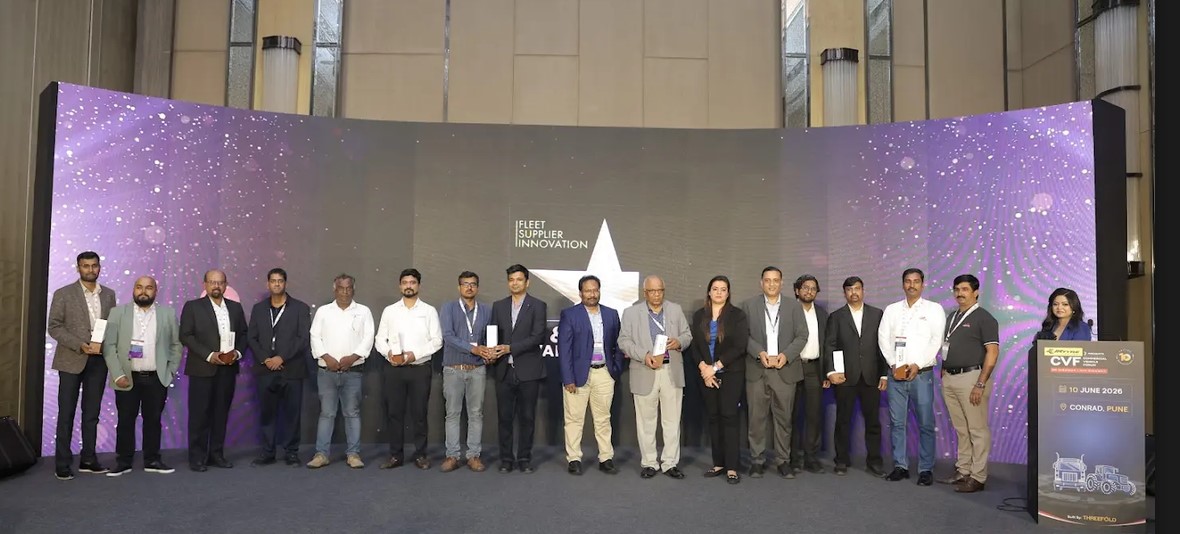
The day closed with the Commercial Vehicle & Fleet Awards 2026, recognising excellence across the CV and road transport ecosystem.
Award Winners
- CVF Most Admired Auto Supplier for CV – SPAL
- CVF Most Admired Alternative Fuel Fleet Trailblazer of the Year – Blue Energy Motors
- CVF Most Admired Operational Efficiency Star of the Year – Allcargo Gati Limited
- CVF Most Admired Pioneer in Software Solutions for CV – ZF Commercial Vehicle Solutions
- CVF Most Admired Connected Technology for CV – LightMetrics
- CVF Most Admired Telematics Solution of the Year – Accolade Electronics
- CVF Most Admired Leading Private Fleet of the Year – Chetak Logistics
- CVF Most Admired Company “In It for the Long Haul” – Let’s Transport
As the industry moves toward a future defined by sustainability, digitalization, connectivity, and intelligent mobility, CVF 2026 once again demonstrated the importance of collaboration across OEMs, fleets, suppliers, technology providers, and policymakers. The 10th edition not only celebrated industry achievements but also reinforced the collective vision shaping the future of commercial vehicles in India.